
- November 13, 2026
- Super Admin
- 0

Summary
Effective exam preparation is not only about how much a child studies. Parents can make a meaningful difference by helping children build routines, reduce distractions, revise consistently, manage pressure, and become more independent learners.
Introduction
Exam season can change the atmosphere at home. Study schedules become tighter, expectations rise, and children may struggle with distractions, motivation, or pressure to perform. Parents want to help, but too much supervision can turn studying into a conflict.
The more useful approach is to create the conditions in which children can study well and gradually take responsibility for their own preparation. Families considering a CBSE school in Bhubaneswar can also consider how schools such as KT Global School work with families to support learning, routines, and student well-being.
Table of Contents
▪️ Why Parents Matter During Exam Preparation
▪️8 Practical Ways Parents Can Help
▪️Supporting Board Exam Preparation
▪️What Parents Should Avoid
▪️A Simple Exam-Preparation Routine
▪️Conclusion
▪️FAQs
Why Parents Matter During Exam Preparation
A parent’s role during exams is to provide structure, encouragement, and a calm environment, not to become another teacher. The Central Board of Secondary Education (CBSE) has introduced its 2026–27 Parenting Calendar to strengthen parent-school engagement. A Times of India report on the CBSE Parenting Calendar notes that the initiative is intended to help families navigate academic pressures and changing educational expectations while providing balanced support at home and in school.
Parental support goes beyond checking homework. It includes helping children organise their time, deal with setbacks, and develop independent habits.
8 Practical Ways Parents Can Help
1. Help Create a Realistic Study Routine
A timetable works best when it reflects the child’s actual day. Instead of filling every available hour with study sessions, help your child divide the workload into manageable blocks.
Start with upcoming exams, difficult subjects, and the amount of material that needs revision. Leave space for meals, breaks, family time, and sleep. A realistic plan is more useful than a perfect one that the child cannot maintain.
2. Make Home a Better Place to Study
A child does not always need a separate room, but a consistent study space can make it easier to begin and stay focused. Keep essential books and materials within reach and reduce avoidable interruptions.
KT Global School has previously discussed practical tips on creating a distraction-free study zone at home. The same principle matters during exam season: children need an environment that supports concentration rather than constantly competing for their attention.
3. Encourage Active Study, Not Just Longer Study
Studying for more hours does not automatically mean learning more. Parents can encourage children to do something with what they have studied.
After a chapter, ask them to explain the main idea without looking at the book. They can solve practice questions, write short answers from memory, or teach a concept back to someone else. The aim is to make preparation more active and identify what the child understands.
4. Help With Priorities
When several exams are approaching, children may not know where to begin. Help them identify what needs attention first rather than simply telling them to “study harder.” A useful conversation can cover what is prepared, what needs revision, and what still feels difficult.
5. Monitor Progress Without Hovering
Children benefit from knowing that someone cares about their progress, but constant checking can make them feel watched rather than supported. Set clear expectations together. The American Psychological Association’s (APA) guidance on setting clear expectations for children recommends making expectations specific, involving children in the process where appropriate, and focusing feedback on what they are doing well and how they can improve. Instead of repeatedly asking how many chapters are finished, ask what the child plans to complete that evening.
6. Protect Sleep, Meals and Breaks
Exam preparation can tempt families to treat every spare hour as study time. That approach can leave children exhausted. Sleep is especially important to protect. The APA’s guidance on children’s sleep and learning notes that insufficient sleep in children and adolescents is associated with difficulties involving concentration and learning. Parents can help by keeping basic routines stable and avoiding the idea that staying up late is automatically a sign of hard work.
7. Motivate Without Comparing
Comments such as “Look how much your friend has studied” may be intended to motivate but can shift attention from learning to comparison.
Instead, focus on progress that belongs to the child: completing a difficult chapter, improving a weak area, or following a study plan consistently. Ask what support would help rather than assuming every child needs the same kind of motivation.
8. Talk About Stress Before It Builds Up
A child who seems unusually quiet, frustrated, or worried may need a conversation before another timetable. Ask what feels difficult. Sometimes the issue is uncertainty about where to start, fear of disappointing others, or difficulty balancing several demands. For families dealing specifically with exam anxiety, KT Global School’s guide on managing exam anxiety for CBSE students offers practical guidance that can complement these conversations.
Supporting Board Exam Preparation
Board exams can bring additional pressure because children and families may attach particular importance to the results. Parents can help by separating preparation from panic.
Start by helping the child understand the examination schedule and divide the syllabus into smaller revision targets. Encourage regular practice rather than leaving the entire syllabus for the final few days.
It is also useful to distinguish between preparation and performance. A disappointing practice test does not have to become a statement about a child’s ability. It can show where revision or clarification is needed.
What Parents Should Avoid
A supportive home environment does not mean removing every difficulty from a child’s path. It means helping the child handle those difficulties more effectively.
Parents should try to avoid:
▪️Comparing one child’s marks or study habits with another’s
▪️Creating unrealistic daily schedules
▪️Interrupting repeatedly to check whether the child is studying
▪️Turning every conversation into a discussion about marks
▪️Taking over work that the child should learn to complete independently
The goal is to support responsibility, not replace it.
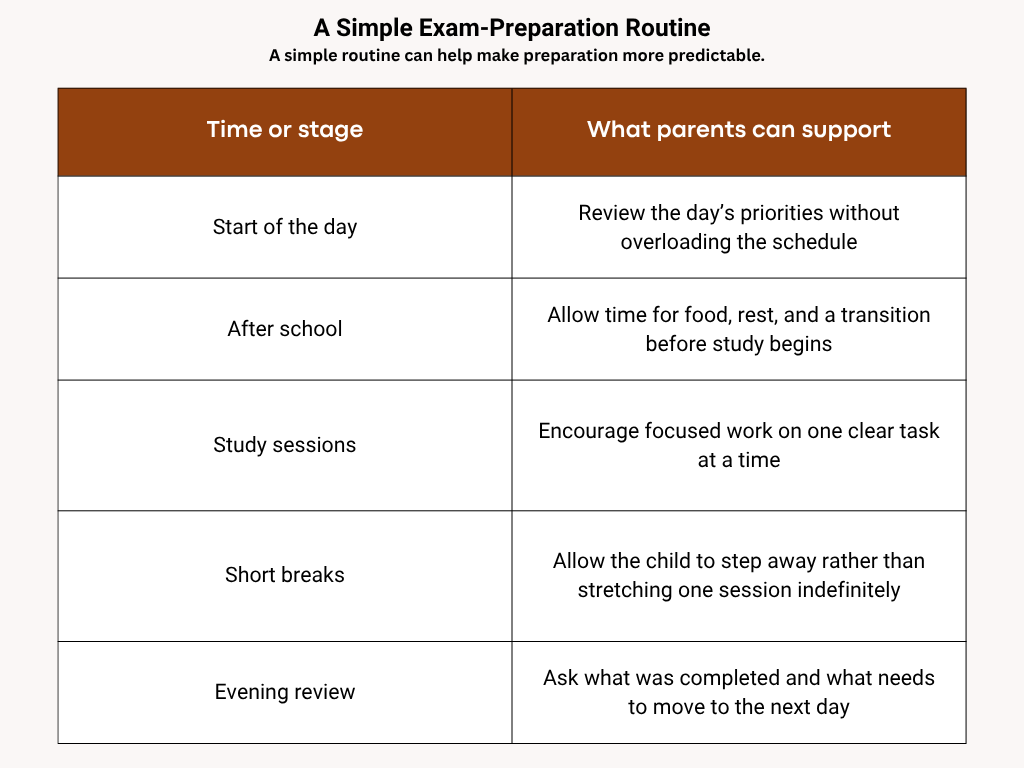
The routine should remain flexible. Younger children may need more direct guidance, while older students can gradually take greater ownership of planning and review.
Conclusion
Good exam preparation is not built through pressure alone. Children are more likely to develop useful study habits when parents provide structure, protect time for rest, encourage steady revision, and remain available when difficulties arise.
For parents evaluating a CBSE school in Bhubaneswar, it is worth considering how the school supports students beyond the classroom. At home, parents can help children build routines, stay focused, and handle setbacks. Parents can contact KT Global School to learn more about its approach to student support.
FAQs
How can parents help children prepare for exams?
Parents can help by creating a realistic routine, reducing distractions, encouraging regular revision, protecting sleep, and providing emotional support. The aim is to support the child without taking over the work.
What are the best exam preparation tips for students?
Useful approaches include breaking the syllabus into manageable sections, revising regularly, practising questions, identifying weak areas, and following a consistent study routine.
How can parents motivate children to study?
Focus on progress rather than comparison. Specific encouragement, realistic goals, and calm conversations about challenges can be more useful than repeated reminders about marks.
How can students prepare for board exams?
Students can prepare by understanding the syllabus and exam schedule, creating a manageable revision plan, practising regularly, and reviewing difficult areas well before the final days.
How can children study effectively at home?
A consistent study space, fewer distractions, clear tasks, and planned breaks can make home study easier to manage. Parents can support these conditions while allowing the child increasing independence.