- March 7, 2026
- KT Global School
- 0
When people search for the best school in Bhubaneswar, they usually compare results, infrastructure, and facilities – where their children can thrive and be their best version.
That makes sense.
But here’s a question most parents don’t pause to ask: Is my child learning how to handle emotions?
Because sooner or later, life stops giving report cards. It starts giving situations. Peer pressure. Failure. Friendship issues. Homesickness. Disagreements.
And emotional intelligence decides how a child responds.
Interestingly, one of the strongest tools for building emotional intelligence isn’t found in a textbook or a classroom. It’s found in festivals. Let’s understand how.
What Is Emotional Intelligence, and Why Does It Matter?
Emotional intelligence (EI) is a child’s ability to recognize, understand, manage, and respond to emotions, both their own and others’. Psychologist Daniel Goleman broke it down into five core components:
◆ Self-awareness: knowing what you feel and why
◆ Self-regulation: managing your reactions
◆ Motivation: staying driven, even through setbacks
◆ Empathy: understanding how others feel
◆ Social skills: building and maintaining relationships
Children who develop these skills tend to perform better not just in exams, but in relationships and leadership roles later in life.
The question is — how can active participation in celebrating festivals build this?
Exposure to Different Cultures Builds Empathy
When children celebrate multiple festivals in school, they don’t just participate. They observe.
◆ They hear stories.
◆ They watch traditions.
◆ They ask questions.
Over time, this reduces bias and builds understanding.
A child who learns why a classmate celebrates Eid or Christmas grows up with perspective. And perspective builds empathy.
Group Celebrations Teach Cooperation
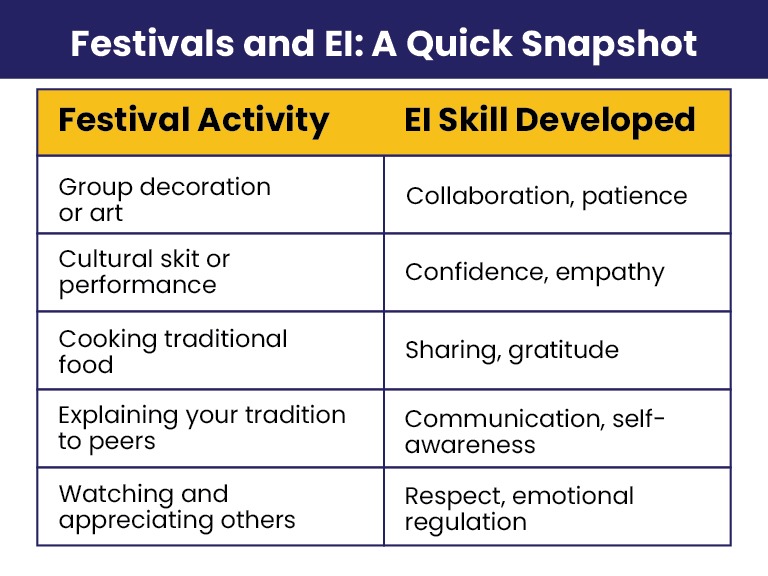
Let’s be practical. Festival events require planning.
● Dance rehearsals
● Decoration teams
● Script preparation
● Food stalls
● Anchoring programs
None of this works without coordination.
Children learn quickly that they can’t do everything alone. They have to listen, adjust, and sometimes compromise. That’s real learning.
Stage Fear and Confidence Go Hand in Hand
Not every child wants to perform on stage. But festivals gently push them to try.
Even small roles — holding placards, helping backstage, reading a line builds confidence. Students staying away from home need opportunities to find their voice.
Confidence grows when children are trusted with responsibility.
Handling Failure in a Safe Space
Let’s not romanticize it. Things go wrong.
Someone forgets steps.
A group doesn’t win a competition.
A decoration idea fails.
But that’s where emotional growth happens.
Students learn that:
● Failure isn’t permanent
● Mistakes aren’t shameful
● Feedback isn’t personal
Gratitude and Social Awareness
Some of the best schools in Bhubaneswar include community outreach during festivals, comprising of donation drives, visits to care homes, or simple acts of appreciation toward support staff.
These experiences shift children’s focus. They begin to understand:
● Privilege
● Responsibility
● Gratitude
Emotional intelligence deepens when children see life beyond their immediate circle.
Other Aspects of Emotional Intelligence Schools Impart Through Festival Celebration
There’s a difference between a school that hosts festivals and one that builds learning around them. The distinction lies in how much agency children are given. When students take charge of planning, decorating, performing, and presenting rather than simply showing up, the emotional stakes feel real.
That sense of ownership is where the actual growth happens. It builds:
● Leadership and initiative — when a child manages a stall or leads a skit
● Conflict resolution — when teams disagree about how to do something
● Emotional communication — when students share what a festival means to their family
Why Residential Schools Have a Unique Role to Play
Residential schools carry a responsibility that day schools don’t quite share. When children live away from home, the school community is their family for most of the year — how that community marks occasions, celebrates differences, and comes together in shared rituals directly shapes a child’s emotional world.
This is why the question isn’t just “does the school celebrate festivals?” but “how?” Are students passive spectators, or are they driving the experience? Is the focus on performance, or is there space to reflect, connect, and even fail a little?
A school’s approach to festivals often reflects its broader philosophy around childhood. It’s worth paying attention to — arguably as much as the academic results board.
If you’re exploring top boarding schools in Bhubaneswar for your child, it might be worth asking how the school celebrates life alongside how it measures achievement. The two aren’t separate questions.
FAQ
1. How do festivals improve emotional intelligence in children?
Festivals create opportunities for teamwork, empathy, expression, and resilience through shared cultural experiences and activities.
2. Are festival celebrations important in boarding schools?
Yes. In a top boarding school in Bhubaneswar, festivals help students feel at home, build friendships, and develop independence while staying emotionally connected.
3. Can festivals impact academic performance?
Indirectly, yes. Children with strong emotional intelligence often manage stress better and perform well academically.
4. How often should schools celebrate festivals?
Schools should celebrate major cultural and national festivals while ensuring inclusivity and educational value.
5. What should parents look for in a school regarding cultural activities?
Look for structured participation, inclusive celebrations, reflection sessions, and leadership opportunities — not just decorative events.