- November 25, 2026
- Super Admin
- 0
Summary:
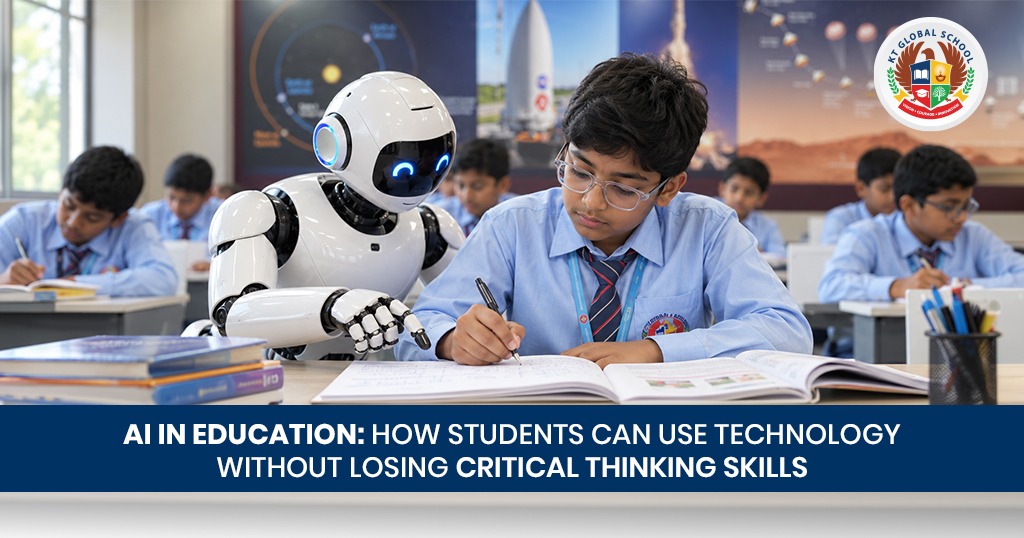
Artificial Intelligence is changing how students learn, research, practise, and create. Used thoughtfully, AI can support learning without replacing the reasoning students need to develop themselves. This article explains practical ways to use AI as a learning assistant, how to question and verify its output, and what schools and parents can do to encourage responsible technology use.
Introduction:
AI can make learning faster and more convenient by explaining difficult concepts, exploring different angles, and generating practice questions. But convenience has a limit: when a tool starts doing the thinking instead of helping a student think, the learning process can become weaker.
That is why the important question is not whether students should use AI, but how they should use it. As AI becomes increasingly visible in education, students need both technological fluency and the habit of questioning, checking, comparing, and forming their own conclusions.
This matters particularly for parents looking for a Top CBSE school in Bhubaneswar. A school’s approach to AI should be considered not simply by the technology it provides, but by whether students are also learning to reason independently and use technology responsibly.
What Is AI in Education?
AI in education refers to the use of artificial intelligence to support teaching, learning, assessment, accessibility, and other educational activities. For students, this can include generative AI tools that explain concepts, suggest examples, organise ideas, or provide feedback.
The important distinction is between using AI to support a learning process and using it to bypass that process. UNESCO’s AI Competency Framework for Students places critical judgement, ethics and a human-centred mindset at the centre of AI literacy.
The growing role of AI in CBSE education also reinforces the importance of this balance. CBSE’s 2026-27 Curriculum Framework for Computational Thinking and Artificial Intelligence highlights logical reasoning, problem-solving, digital literacy, ethical technology use, creativity, and critical thinking.
How Students Can Use AI as a Learning Tool
AI can be useful when the student remains the person making the decisions.
1. Understand difficult concepts
Instead of asking an AI tool to complete a worksheet, a student can ask it to explain a difficult concept in simpler language, give an everyday example, or present the same idea at another level. The student can then return to the textbook and check whether the explanation matches the lesson.
2. Generate practice material
Students can use AI to create quiz questions, revision prompts, flashcards, or practice problems based on a topic they have already studied. This makes AI a practice partner rather than an answer machine.
3. Brainstorm before writing
For essays, projects, and presentations, AI can help generate possible angles or organise a set of ideas. The student should still choose the argument, develop the reasoning, and write the final work independently.
4. Ask for feedback
AI can identify unclear sentences, possible gaps in an explanation, or weaknesses in an argument. The student should then decide which suggestions are valid rather than accepting every recommendation automatically.
A useful rule is simple:
Use AI to expand your thinking, not to outsource it.
For parents comparing the best CBSE school in Bhubaneswar, this distinction can also be a useful question to ask about the school’s approach to technology: are students merely being given tools, or are they being taught how to think with those tools?
When AI Starts Doing the Thinking
The main educational concern is not simply the presence of AI. It is passive dependence on it. Consider two students preparing an answer. One copies an AI-generated response, while the other develops an answer first, uses AI to challenge or refine it, verifies the information, and then rewrites it independently. Both use technology, but only one remains actively involved in the learning process.
Over-reliance can also create a false sense of confidence. AI systems can produce fluent responses that contain errors, omissions, or unsupported claims. Students therefore need to develop the habit of checking information rather than assuming that a polished response is automatically correct. UNICEF’s guidance on AI and children emphasises safety, privacy, transparency, fairness and the need to prepare children for developments in AI.
Five Ways to Protect Critical Thinking
Ask before you accept
Before using an AI-generated answer, ask: Does this make sense? What evidence supports it? Could there be another explanation?
Verify important information
For facts, quotations, dates, statistics, or scientific explanations, compare the AI response with the textbook, teacher-provided material, or reliable external sources.
Do the first attempt yourself
Try solving the problem, forming the argument, or explaining the concept before asking AI for help. This preserves the mental effort involved in building understanding.
Use AI for questions, not just answers
Ask the tool to challenge an argument, generate counterexamples, identify assumptions, or suggest questions you have not considered. This turns AI into part of an inquiry process rather than a shortcut.
Reflect on the final answer
After using AI, close the tool and explain the idea in your own words. If you cannot explain it without looking back at the generated response, more learning may be needed.
What Responsible AI Education Looks Like in CBSE Schools
AI literacy should not be reduced to knowing how to operate a tool. Students also need opportunities to investigate, create, debate, test ideas, and learn from mistakes. Technology works best when it sits alongside discussion, experimentation, research, and hands-on learning.
Students can question an AI response, compare sources, solve a problem without digital assistance, and then use technology to extend the work. For a broader look at how AI is being discussed in the CBSE context, our earlier blog on CBSE schools with AI learning in Bhubaneswar explores its growing role in a school environment.
KT Global School describes its approach through experiential learning, design thinking, and creative workspaces. Its academic facilities also include a Makers Space and Fab Lab that provide hands-on opportunities in science, technology, and engineering. Parents exploring CBSE-affiliated schools in Bhubaneswar can look for similar evidence of how technology is connected to actual learning experiences rather than treated as an end in itself.
Conclusion
The purpose of AI in education should not be to make every school task faster. It should be to help students learn more effectively while preserving the human abilities that remain essential: curiosity, judgement, reasoning, creativity and the confidence to form an independent view.
For families researching a Top CBSE school in Bhubaneswar, a useful way to assess a school’s technology approach is to look beyond devices and software. Ask how students are encouraged to question information, work through problems, conduct research, create original work, and use AI responsibly. Families can contact KT Global School to learn more about how its educational environment brings technology and experiential learning together.
FAQs
Q1- Is AI useful for school students?
Yes. AI can support explanation, practice, brainstorming and feedback when students remain actively involved in the learning process and evaluate the output.
Q2- Can AI reduce critical thinking?
Over-reliance on AI can reduce opportunities for students to practise independent reasoning. Using AI to question, compare and improve ideas is different from using it to replace the thinking process.
Q3 - How can students check AI-generated information?
Students should compare important information with textbooks, teacher guidance and reliable sources, particularly for facts, dates, quotations and technical claims.
Q4- What should students avoid when using AI for schoolwork?
Students should avoid copying AI-generated answers without understanding them, submitting AI-written work as their own, relying on AI for every task, and accepting its responses without checking whether they are accurate or appropriate.
Q5 - What should parents look for in AI education?
Parents can look for a balance of technology and human-led learning, including inquiry, discussion, problem-solving, creativity, hands-on activities, responsible technology use, and opportunities for students to work independently.